
Sources for Davis Previous Residents
A previous residents search needs more than one era. The table separates the title chain from the household layer. Yolo deed and official books reach from 1850 to the present, but the remote index has conflicting county descriptions of a 1960 versus 1970 start. Archives hold older tax rolls and maps. UC Davis and Yolo collections add dated directories, yearbooks, newspapers, obituaries, and Sanborn context. Each source shows a role, not an entire household.
| Source | Years It Covers | Where Held | What It Shows |
|---|---|---|---|
| Recorder deed and official books | 1850-present | Woodland lobby, microfilm, copies | Chain of title and legal description |
| Online grantor-grantee index | 1960-present, per Recording page | Yolo official-record portal | Parties, type, date, reference |
| Online official-record indices | 1970-present, per Online Services | Yolo official-record portal | Indexed official records |
| Assessment and tax roll | Current; archives about 1850s-1970s | Assessor, Tax, Yolo Archives | Assessee, situs, mailing, values |
| Campus directories and yearbooks | 1931-2009; 1950-1970 yearbooks | UC Davis / Yolo Archives | Dated affiliation and people leads |
| Sanborn and permits | Sanborn 1921-1941; permit start unverified | Yolo Archives / Davis | Structure, use, work, inspection clues |
| Federal census | Through 1950 public | NARA and research partners | Enumerated households by date |
Start with the APN for a modern address, use the deed chain for owners, and move to directories or census when the question is who occupied the place. A city directory's collection details belong on the Davis city directory page; the backward trail belongs here.
Start Davis Previous-Resident Research with the APN
Street numbers can change, split, merge, or sit on a parcel with a different legal description. Resolve the current Davis address through Yolo Tax Inquiry or the public GIS viewer, save the 12-digit APN, and copy the legal description and latest recorded reference. The public Assessor web interface is not a verified owner-name directory. Counter or limited phone service supplies richer current-roll fields within Revenue and Taxation Code section 408 limits.
Keep four identities apart: situs is the physical taxed location, mailing address is where a notice goes, assessee is the roll role, and titled grantee is the recorded party. A mailing mismatch can suggest an owner lives elsewhere, but it does not identify a past occupant. The APN and legal description give the previous residents workflow a stable anchor when a street label changes.
- APN
- Assessment parcel number used to connect the parcel to tax and assessment systems.
- Situs
- Physical parcel location, distinct from an owner's correspondence address.
- Legal description
- Lot, block, subdivision, or other title language that can outlast a street-number change.
Trace Davis Previous Residents Through Deeds
Yolo County Clerk-Recorder records state that deed books and official records are held from 1850 to the present. The online official-records search uses Grantor, Grantee, Document Number, Document Type, and Recording Date. Search the current owner as grantee, isolate the acquisition deed, then use that deed's seller as the next earlier grantee. Keep the instrument number, book and page, legal description, recording date, and parties in an ownership table.
- Resolve the current address to its APN, legal description, and latest recorded reference.
- Search the current titled name as grantee and isolate the acquisition instrument.
- Read the seller or grantor and search that party as an earlier grantee.
- Repeat the loop, checking the legal description at each interval.
- Switch to the Woodland kiosk, microfilm, and deed books for the earlier years when the web index ends.
- Grantor
- The party conveying an interest in the recorded instrument.
- Grantee
- The party receiving the recorded interest.
- Chain of title
- A linked sequence of recorded transfers for one legal parcel.
A deed proves title or a recorded interest. It does not prove that the grantee lived at the Davis address. Pair each ownership interval with household evidence.
The Davis 1960/1970 Web Index Gap
Yolo's public pages disagree about the beginning of remote coverage. The Recording page says grantor-grantee web indexing begins in 1960. Online Services says official-record indices begin in 1970. Both can be reported without choosing one as a universal cutoff. The county's 1850-present holdings are broader than either web statement.
For a pre-cutoff Davis transfer, use the Woodland Recorder lobby kiosk or microfilm and ask about deed books. The Recorder's B-01 phone is 530-666-8130 for copy and payment questions; staff do not perform an open-ended chain search. Regular copies may be emailed for the delivery charge, while certified copies are mailed. The recorded-copy form accepts a recording date, name, book and page, instrument reference, map reference, copy type, requester information, and payment method.
Carry the exact county citation into the next search. A missing web row can mean the date is before coverage, a name variant was missed, an image is kiosk-only, or the document sits in a different record series.
Sanborn Clues for Davis Previous Residents
Yolo Archives holds a Davis Sanborn map described as covering 1921-1941. Sanborn material can show a building footprint, use, and address continuity at a dated moment. It cannot name every resident, and an absence may mean the parcel was outside the mapped extent or the structure came later. Compare the map with tax rolls, deeds, directories, newspapers, and planning files.
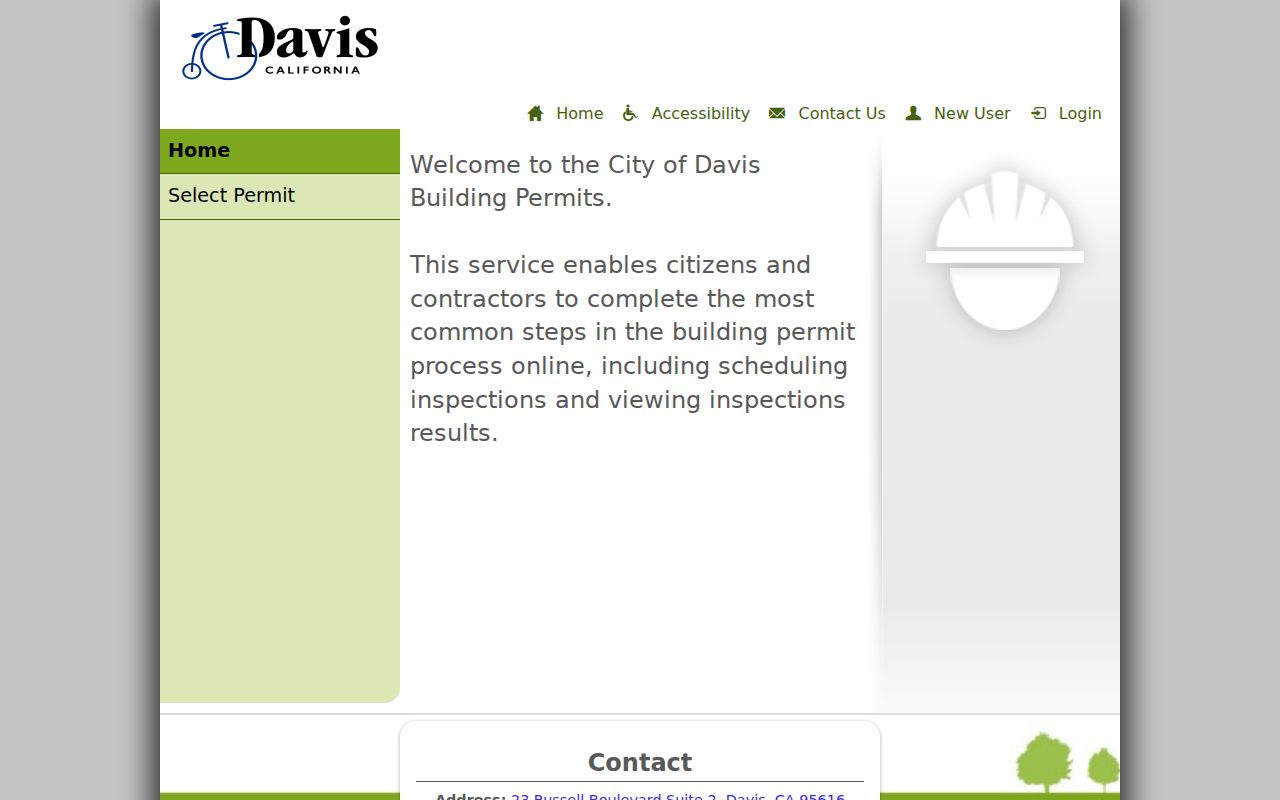
The Davis permit portal supplies scheduling, inspection, and status information. A permit number resembles BLDG-2024-XXXXX, and an inspection request uses permit number, type, address, site contact and phone, and a time window. Historical coverage is unverified. An applicant, contractor, or contact is a project role, not a confirmed member of the household. A focused City Public Records Act request can seek an existing older permit jacket or code file.
The Davis permit portal is the current-work clue in a previous residents search.
Permit dates help place construction or remodeling between ownership intervals; they do not fill the occupant field by themselves.
Pair Davis Previous Residents with Directory Years
Owners are only one layer of previous residents. A dated directory, yearbook, census schedule, newspaper, or obituary can show who was associated with an address or institution at a particular time. UC Davis Campus Directories are documented from 1931-2009. Yolo Archives holds Davis High yearbooks from 1962-2022 with gaps, UC Davis yearbooks from 1950-1970, and school reports from 1865-1949. The verified commercial Davis criss-cross run remains an open research question.
- Record the house number, street form, edition date, page, and the publication's coverage statement.
- Search the directory's name section, then use an address section only if the librarian confirms its scope.
- Pair the directory period with the public 1950 census or the nearest available historical source.
- Compare names, household members, address, school, organization, and move dates without treating absence as proof.
- Close the trail with newspapers, cemetery or obituary material, probate, a distribution deed, or a vital copy.
Use the collection method on the Davis city directory page for the shelf and reading key. An address history should tie every directory result to the APN and an ownership or structure date.
Historical caution. The 1950 census is public under the 72-year rule; later census responses are not yet open in the same way.
Obituaries and the Davis Previous-Resident Heir Trail
For family-history work, the strongest local endpoint can be obituary to probate to deed. Yolo Archives has reported more than 25,000 obituaries along with church and cemetery records. An obituary can identify relatives, an address, an organization, or a date. Probate petitions and wills can identify heirs, estate property, and later distribution. A deed can then show how title moved after death. Each step has a different source and should not be collapsed into one name claim.
Search surname variants, former names, street terms, spouse names, organizations, and Davisville. Use the Davis Cemetery District for interment inquiry and local newspapers for memorial context. Verify a relationship with a vital or court record when it matters. An heir's filing address can be a useful contact clue without being proof that the heir lived at the old Davis house.
| Obituary | Reported death, family, organization, and sometimes address context. |
|---|---|
| Probate | Estate, heirs, petition, will, and distribution trail in a court or archive file. |
| Distribution deed | Recorded transfer after an estate event, subject to the deed's legal description. |
| Vital copy | Custodian-issued birth, death, marriage, or dissolution record under eligibility rules. |
Davisville Postal History for Previous Residents
Old Davis addresses can carry the Davisville label before incorporation in 1917. Later postal history adds another continuity trap: El Macero's preferred last line changed to Davis on April 8, 2004, and part of its territory shifted from 95616 to 95618 on July 1, 2004. A prior resident search should preserve both forms when the address interval touches the change.
Postal labels do not replace a legal description. Use historic maps, tax rolls, Sanborn, planning minutes, subdivision files, and the County Archives when a street number seems to vanish. College Park Association records from 1923-1973 can add neighborhood context, while Davis Land Records D-032 at UC Davis provides manuscript context beside county-certified instruments. The research gap itself belongs in the evidence log.
Evidence Ledger for Davis Past Residents
Finish a previous residents project with a source ledger. For each row, write the source, date or coverage, name, role, address type, parcel or case reference, access channel, and reliability. Separate owner, tax mailing recipient, listed occupant, enumerated household member, campus affiliate, permit contact, obituary relative, and heir. That vocabulary prevents a title chain from being mistaken for an occupancy list.
Archive findings, online indexes, copies, and interviews with staff should each retain their own citation. The Recorder certifies official instruments. The court clerk certifies court material. A catalog describes custody. A newspaper or obituary reports information. If the current evidence ends at a trust, entity, protected address, missing index year, or unverified directory run, record the stopping point rather than filling it with inference.
Lawful house history. Davis previous residents research is appropriate for family history, preservation, and personal curiosity. Do not use an old address trail to stalk, harass, intimidate, or harm a living person.
Past residents are historical evidence, not a shortcut to a person's present whereabouts. The current address chain belongs with the Davis street and parcel records, and every conclusion should match the exact source role.