
How Davis Residents Are Found
Start a Davis residents directory search by naming the question first. A current parcel question belongs with the Yolo Assessor and Tax Inquiry tools. A transfer or lien question goes to the Yolo County Clerk-Recorder. A court-party question belongs to the Superior Court of California, County of Yolo. Older names surface in UC Davis directories, the Yolo County Archives, yearbooks, newspapers, cemetery material, and obituary collections. These sources overlap. Each still records a different role and date.
Ownership, tax mailing, voter registration, a court appearance, a directory listing, and physical presence are not the same thing. A deed names recorded parties. An assessment roll names a taxpayer or assessee. A directory entry is a dated publication line. A voter search confirms only the authenticated user's own status. A careful Davis residents directory workflow keeps those boundaries visible. It also demands a second source before any match counts as meaningful.
- Write down the full name, variants, likely date range, and the one fact that should distinguish the person.
- Resolve a known address or parcel through Yolo tax inquiry, the Assessor, or the public GIS viewer.
- Search the Clerk-Recorder index for a party, document type, recording date, or instrument reference.
- Use the Yolo court portal, a state license search, a directory, or an archive according to the question.
- Request the underlying copy from the custodian when a summary needs proof or when no web index exists.
Davis Records Offices Behind the Directory
Davis records spread across city, county, court, university, and state systems. The consolidated Yolo County Assessor, Clerk-Recorder, and Registrar of Voters department sits in Woodland. Many a Davis search therefore leaves the city. The City Clerk keeps municipal records. It uses a NextRequest route for focused California Public Records Act requests. The Building Division holds permits, inspections, plan review, and code files. Each office can release an existing record within its rules. A custodian does not have to build a fresh list of residents from several databases.
For a current Davis residents directory question, begin with the office that owns the record. The Clerk-Recorder index is free to search. Document images live at the lobby kiosk. Copies follow the county's payment and delivery process. The Assessor's public web tool is APN-forward. Elections data stays protected by purpose and authentication. Court, vital, and archive access each carry their own eligibility or reading-room limits.
One Davis Search, Four Record Geographies
A Davis name can cross four distinct record geographies. City records cover local government action. Yolo County holds deeds, assessment material, court files, county elections, archives, and vital copies. California systems cover voter self-status, professional licenses, business filings, offender information, and statewide vital applications. UC Davis and county collections add a university and regional history layer. That split matters. One Davis residents directory result can never stand in for a complete identity check.
The Yolo official-records search shows the county route well. A free index search runs on Grantor, Grantee, Document Number, Document Type, and Recording Date. It points to a legal instrument, not necessarily a current home. One recorder page puts web grantor-grantee indexing starting in 1960. Another county page puts official-record indices at 1970. Keep both statements in mind. For earlier work, switch to the Woodland kiosk, microfilm, or deed books.
A Davis property trail may depend on a recorded party. It may also turn on an instrument reference. Either way, the county's official search screen is the strongest starting point.
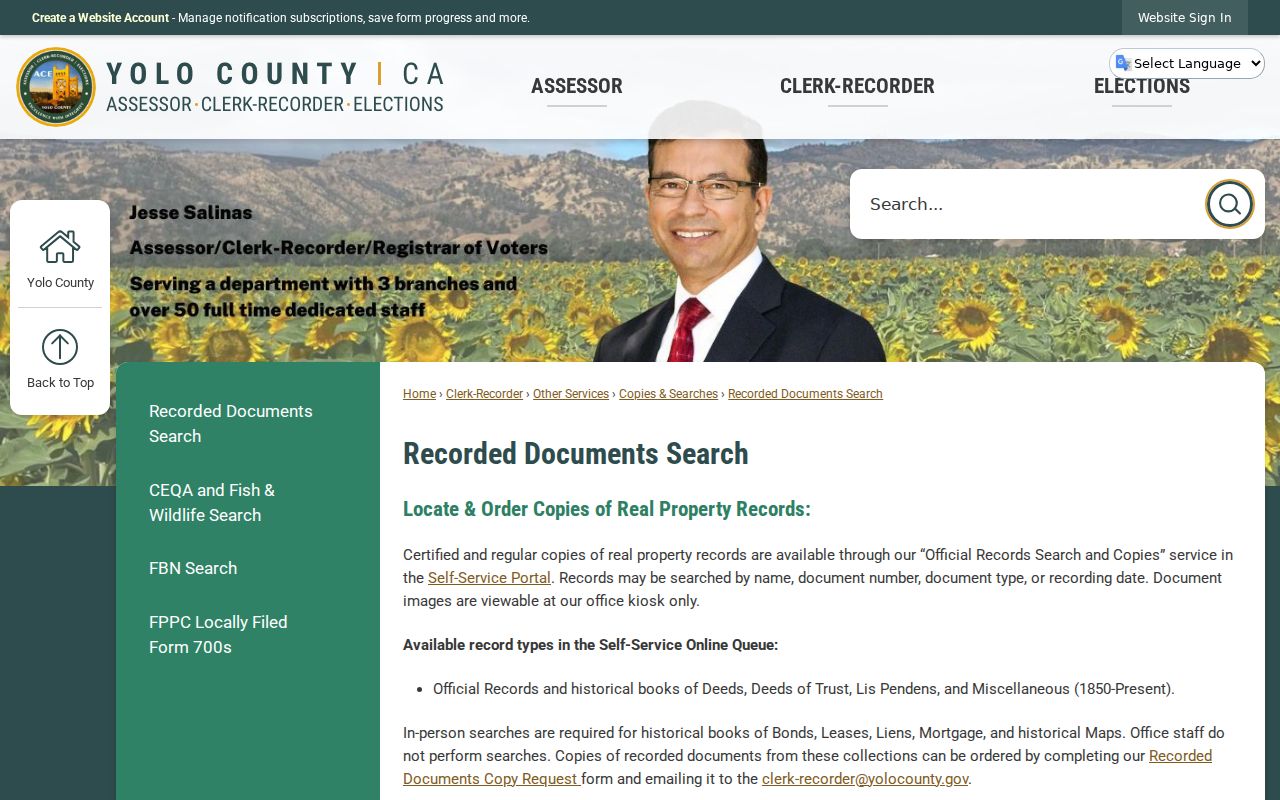
The index image makes the key distinction plain: an official-record result is a dated lead to a document, and the certified or plain copy itself comes from the Clerk-Recorder.
Current Davis Resident Sources
No single current Davis residents directory lists every household. The practical set below is a collection of partial records. Some are open for a free search. Some require authentication or a qualified purpose. Some are only leads to a copy request. The safest result statement names the record role: titled party, assessee, court party, licensee, or authenticated voter.
| Source | What It Lists | Keeper | Access |
|---|---|---|---|
| Assessment and tax inquiry | APN, situs, assessee, mailing clue, values | Yolo Assessor / Tax | Web, counter, limited phone |
| Official-record index | Grantors, grantees, document type and date | Yolo Clerk-Recorder | Free index; copies paid |
| My Voter Status | One authenticated voter's status and address | California Secretary of State | Self-lookup only |
| Superior Court docket | Parties, case number, type, status and register entries | Yolo Superior Court | Portal; copy rules apply |
| License and entity searches | Licensee or filing entity, status and public address | California boards / SOS | Free public search |
| Archives and directories | Dated affiliation, household, school, or obituary lead | UC Davis / Yolo Archives | Catalog, Aeon, reading room |
The table is a routing aid, not a promise of a Davis address from each source. The Davis resident lookup workflow works best when two records agree on a date and role, then the underlying instrument or file gets checked.
Yolo Assessor: Not a Davis Directory
The Yolo Assessor's public portal is built around the parcel number. Owner-name searching is not part of the public interface. Start with a known parcel or location instead. From there, the APN carries into assessment rolls, tax records, GIS, and recorder work. Staff at the public counter can read current roll fields within Revenue and Taxation Code section 408 limits. A phone call covers ownership, mailing address, APN, latest deed, and assessment details for up to three parcels.
The tax inquiry is the nearest thing to a whole-street route. Its selector takes Property Address or Fee Parcel. The documented search type is "Begins With." Suffixes and directionals matter here. Drop Street, Road, Drive, or Lane when the portal instructions call for a shorter form. Keep every returned APN before assuming a Davis street segment is complete.
| Fee Parcel | Required text criterion for the public Assessor inquiry; use the assessment parcel number. |
|---|---|
| Search by | Required selector with Property Address or Fee Parcel. |
| Search Type | Documented option is Begins With; other options are not assumed. |
| Search Criteria | Required address string or 12-digit assessment number. |
| Roll fields | Assessee, situs, mailing address, values, exemption, revenue district, and latest recorded document. |
A mailing address is where mail goes, not proof anyone lives there. A homeowner exemption is evidence of a claim, not conclusive proof of occupancy at the Davis parcel.
Davis Voter Status Is a Self Check
California's My Voter Status tool is not a public Davis residents directory. It requires first name, last name, and full date of birth. It also requires either a California driver's license or identification number or the last four digits of a Social Security number, with alternate checkboxes where applicable. Once authenticated, it can display registration status and address. It can also show party preference, language preference, election details, vote-by-mail or provisional status, county contact, and voter-guide delivery.
The design tells you what it is for. It confirms one person's own record. It cannot lawfully be turned into a street browse. Restricted voter-file access under Elections Code sections 2188, 2194, and 18109, Government Code section 7924.000, and 2 CCR sections 19001-19013 demands an eligible applicant, a stated purpose, security details, and the proper voter-file application. Commercial use is prohibited. A request for one voter is not a request for unidentified people on a Davis block.
The state authentication form makes that privacy boundary plain before a lawful self-check even begins.
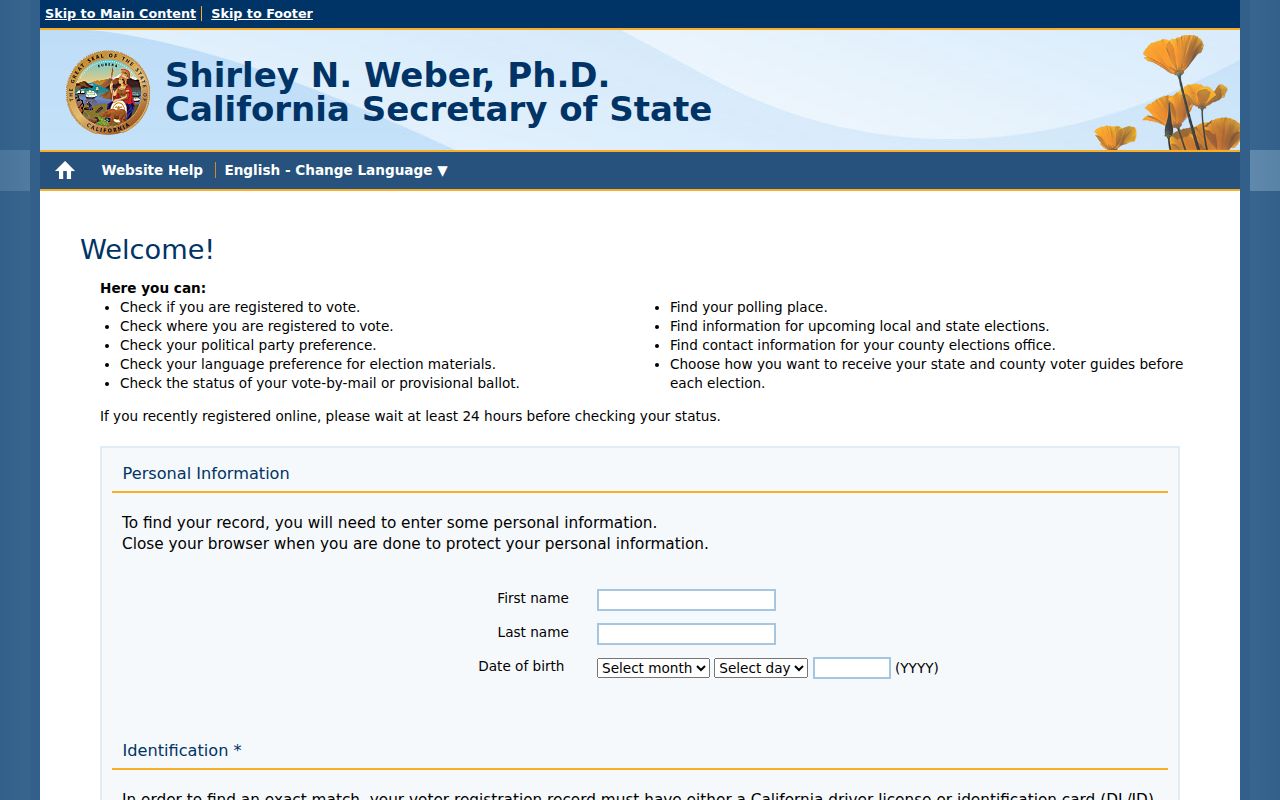
A voter-status result confirms one dated self-record. It is not a roster of Davis neighbors.
Note: Wait 24 hours after registering online before treating the self-status result as settled, and use the dated county contact for corrections.
Davis Court Records and Parties
Yolo Superior Court serves Davis from Woodland, with no separate municipal tier for ordinary cases. The public Yolo case portal supports both ordinary and Advanced name searching. A result can show the case number, title and parties, filing date, and type. It also lists status, calendar entries, and register-of-actions items. Civil, criminal, family, juvenile, and adoption material each follow their own access rules. Sealed records and older offsite material do too.
A party in a case is a role, not a finding that someone lives in Davis. Nor is it proof that an allegation was proven. Inspect the register before ordering anything. For a civil copy, the route can use a case number, parties, the wanted document, and a check. Add a self-addressed envelope too. Yolo's research notes list $0.50 per page, $40 for certification, and $15 for a search. The clerk should confirm current charges.
The portal's own display shows why a Davis resident lookup should separate a searchable summary from the filed record itself.
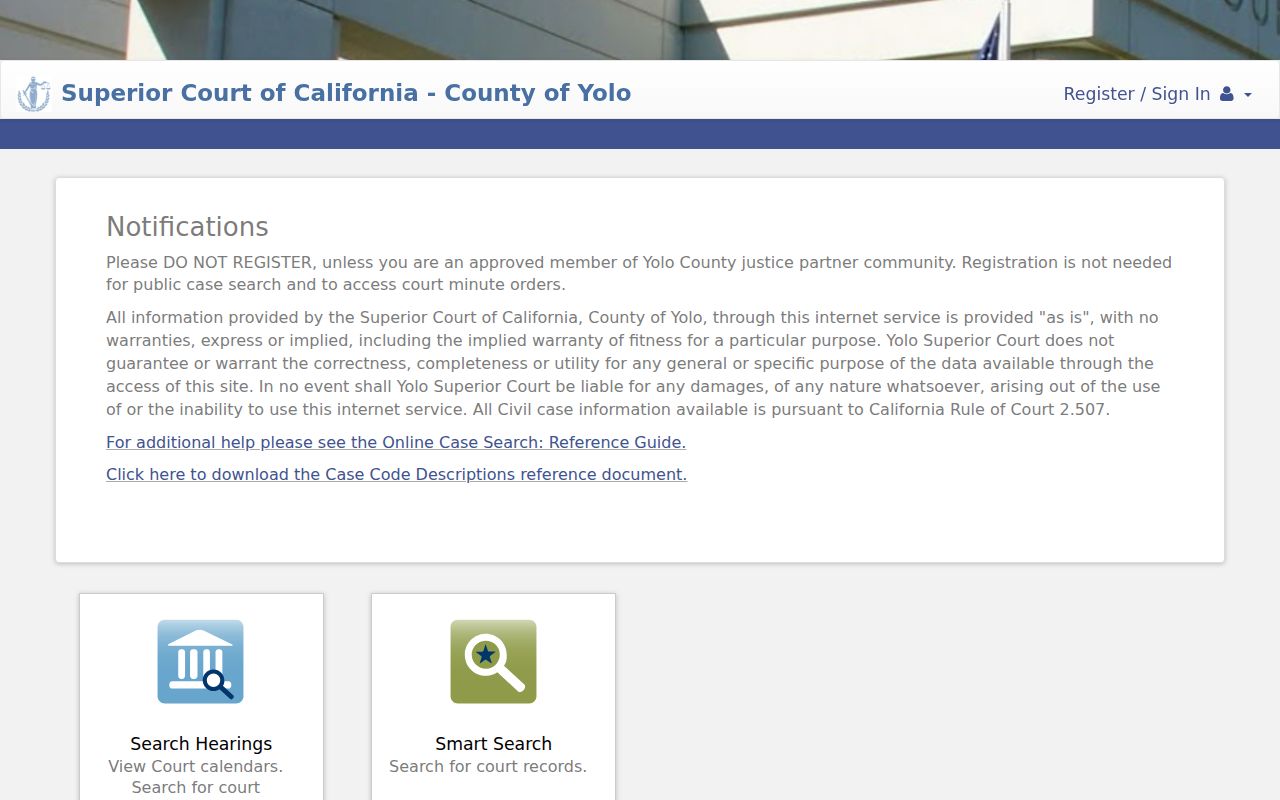
Order copies through the Yolo clerk. For federal matters, use Eastern District of California or PACER separately.
- Case number and title identify the court file.
- Parties and filing date anchor the name to a proceeding.
- Type and status describe the docket's posture.
- Register entries show events, not every document or final outcome.
- Restricted categories may return less than the clerk's public file.
Davis Vital Records for Resident Research
Birth, death, marriage, and dissolution records follow California access rules, not a general public Davis name index. Yolo County Clerk-Recorder handles local copies. CDPH-Vital Records supplies statewide applications. Statewide birth registration starts in July 1905. Earlier Davis events call for county registers, church or cemetery evidence, newspapers, probate, family papers, and archives.
| Record | Copy path | Eligibility or limit | 2026 fee |
|---|---|---|---|
| Birth | Yolo or CDPH | Authorized statutory person or informational copy | $31 |
| Death | Yolo or CDPH | Authorized person or informational copy | $26 |
| Public marriage | Yolo or CDPH | Authorized or informational copy | $19 |
| Confidential marriage | Issuing county | Spouses or court order | $19 |
| State dissolution certificate | CDPH | Application rules; not the court judgment | $18 |
An authorized certified copy can establish identity for an eligible requester. An informational copy is marked invalid for that purpose. Authorized requests by mail or fax need the form's sworn and notarized statement. CDPH reports an average certified-copy turnaround of four to six weeks. County channels are often faster. The fee is retained when it issues a Certificate of No Public Record.
Check the authorized versus informational explanation, current CDPH vital-record forms, and the state fee schedule before sending a Davis request.
Davis Business Records in the Residents Directory
A person tied to a Davis business can surface in several records. One is a city license. Another is a Yolo fictitious business name filing. A third is a California Secretary of State entity record. Each answers a different question. The City of Davis license is a local registration and tax record. A county FBN filing links a DBA to its filer. SOS bizfile identifies an entity, agent, status, filing dates, and addresses. It does not claim to show ownership. None of those roles establishes a residence on its own.
The California business search takes a name or file number. Advanced filters cover entity type, status, and initial filing-date range. A basic list stops at the 500 closest matches. Entity detail can show legal name and number, status, jurisdiction, street and mailing address, agent, Statement of Information due date, and filed PDFs. Record the search date. Status and addresses change.
| Source | Best question | Useful result |
|---|---|---|
| City license | Was a business registered locally? | DBA, activity, public business address, responsible-person role |
| Yolo FBN | Who filed a fictitious business statement? | Filer and recorded statement image route |
| SOS bizfile | What entity filed with California? | Entity status, agent, address, filings, dates |
The business result screen helps when a Davis name appears in a public filing. Just keep the filing role precise.
Confirm labels with the office that issued the record.
| Route | Strength | Limit |
|---|---|---|
| Official county, city, state, court, library, or archive source | Named custodian, dated fields, access rules, and a copy route | May be partial, restricted, offline, or slow to update |
| Commercial data compilation | May gather public leads in one search | Can merge people, go stale, charge for access, and cannot certify a Davis record |
Historical Davis Resident Directories
A dated household or institutional tie is the real payoff of a historical Davis residents directory. UC Davis Special Collections holds Campus Directories from 1931 through 2009, and the linked catalog record describes the collection and its reading-room route. Entries cover campus people, departments, locations, and telephones. Yolo Archives widens the shelf. Its Davis holdings include high school yearbooks from 1962 through 2022 with gaps, UC Davis yearbooks from 1950 through 1970, school reports from 1865 through 1949, newspapers, photographs, maps, tax rolls, and obituary material.
The campus shelf is not a town roll. A campus directory can skip a non-campus household. An absence means only "not listed in this edition." The Davis city directory collections page digs deeper into the historical shelf, catalog routes, and how to read an entry. One more tip matters for early searching. Records predating the city's 1917 incorporation often sit under the name "Davisville."
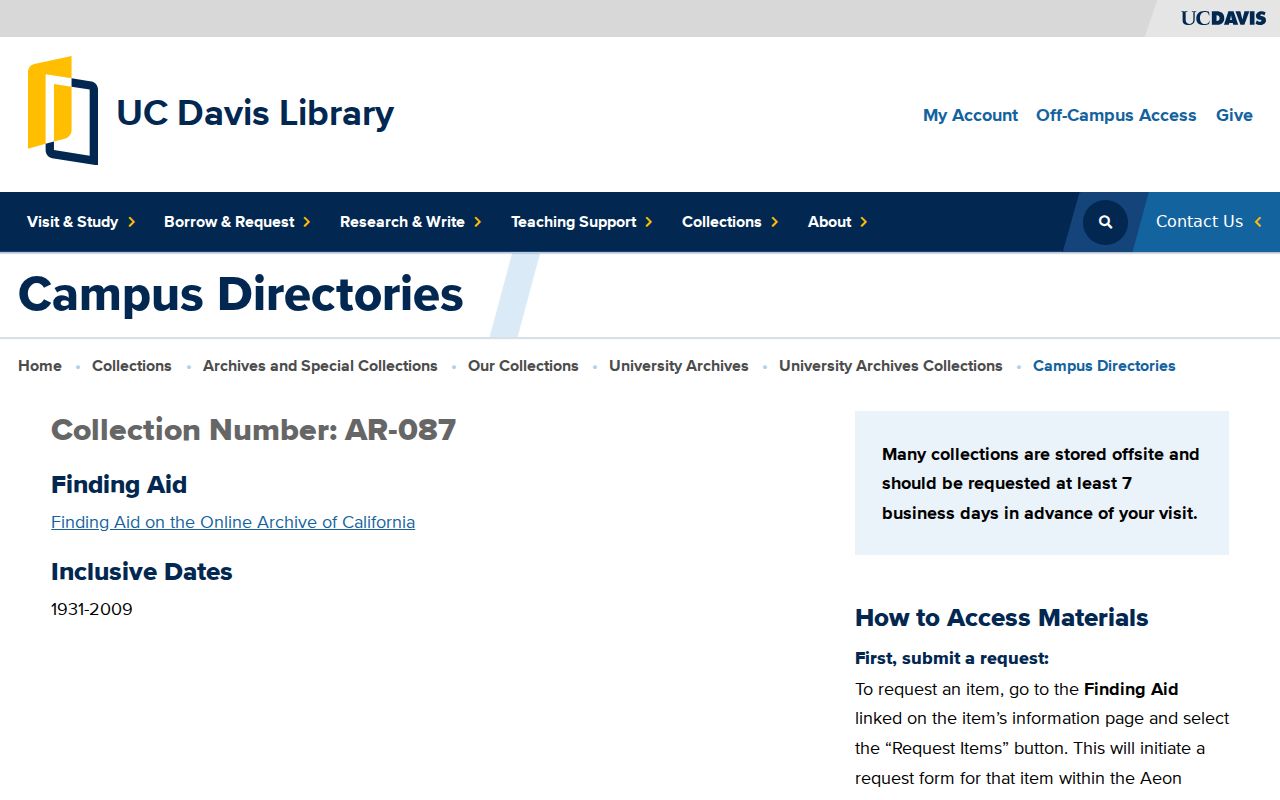
Use the dated institutional clue as a lead. Then compare it against county deeds, archives, newspapers, or a court or vital record.
Davis Archives Behind Historical Directories
Two archive systems anchor most Davis research. Yolo County Archives spans the 1850s to today. Its shelves hold assessor rolls and maps from roughly the 1850s through the 1970s, school material, newspapers, and cemetery records. A Davis Sanborn map covers 1921 to 1941. Planning minutes run from 1920 to 1940. The obituary collection reportedly tops 25,000 items. UC Davis Archives keeps City of Davis material, Davis Land Records D-032, College Park Association D-512 from 1923 to 1973, Davisville 1905 D-450, photographs, and campus serials.
A downtown business fire once pushed demand for city services. That means fire, rebuilding, business, deed, and early city records can all converge on one address. Discovery runs on two tracks. The county uses an Axiell catalog, while UC Davis Digital Collections supports browsing, collection context, citations, a book reader, and OCR search. Offsite UC materials need an Aeon request at least seven business days ahead. County holdings stay in the reading room.
For an old Davis name, search Davisville, a street or subdivision, a family or organization, and the record format instead of trusting one spelling.
Davis Privacy Programs for Resident Searches
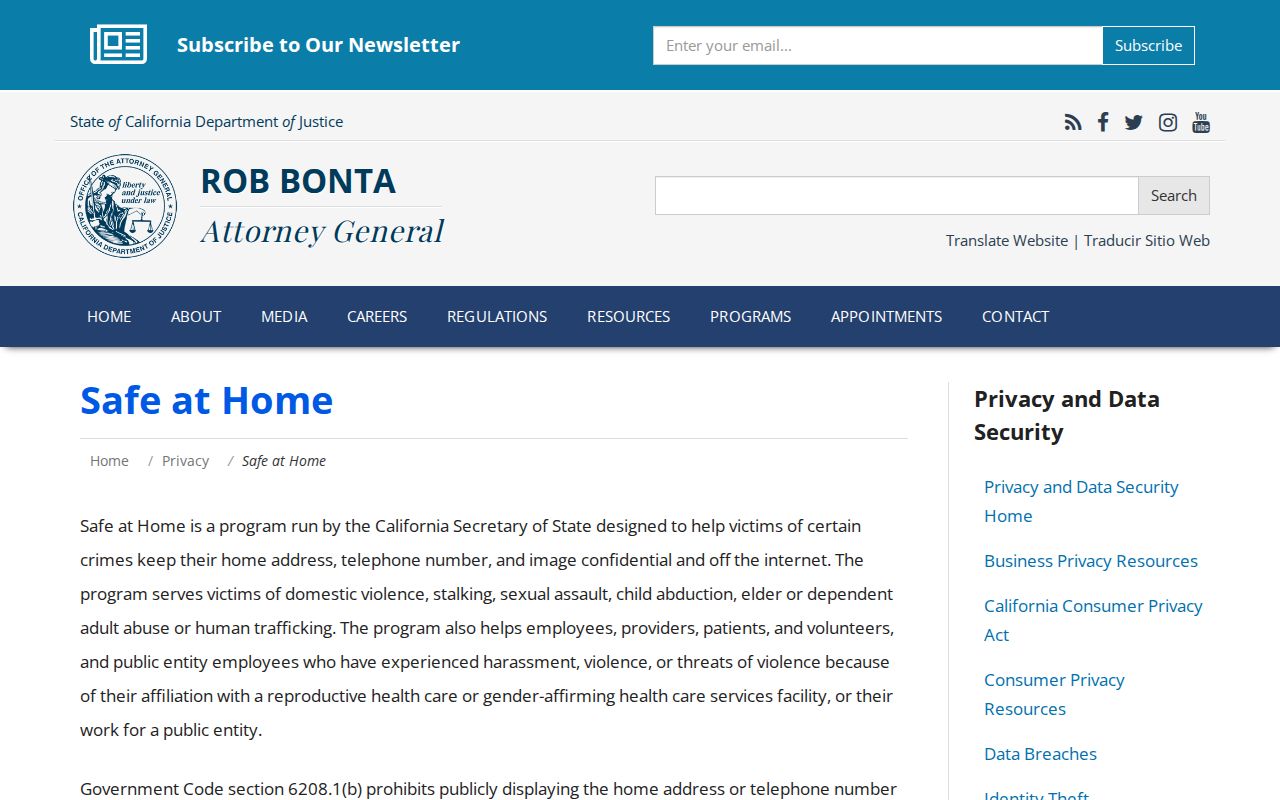
A missing address can be a legal safeguard. Safe at Home gives qualifying Californians a substitute address. It covers victims of domestic violence, stalking, sexual assault, child abduction, elder or dependent abuse, trafficking, and specified reproductive or gender-care participants, plus threatened public employees. Government Code section 6208.1 bars publication after a qualifying demand or threatening intent. The program does not purge older records.
The California Delete Act added the DROP platform on January 1, 2026. Broker processing began August 1. A state resident creates a profile, submits identifying details once, and reaches more than 600 registered brokers while tracking the request. DROP erases commercial broker holdings. It leaves Yolo deeds, court files, assessment rolls, and other government records alone. Direct corrections to the source custodian.
The Safe at Home program explains why a protected address may not appear in a Davis residents directory search.
Respect the privacy controls. A record can be lawful to access yet unlawful to use for stalking, harassment, threats, or unwanted contact.
Lawful personal use. Davis records support family history, personal research, civic questions, and scam checking. Do not use a resident lookup to stalk, harass, intimidate, or harm another person.
Davis CPRA Fallback for Resident Records
Some Davis records never make it into an online index. The City Clerk still has them. Under the California Public Records Act, a focused request can pull an existing record, and the clerk promises a determination notice within ten days, extensions permitting. Name the address or parcel, the department, the record type, and a date range. Ask for something identifiable, like a permit jacket, code file, agenda, or correspondence set. Davis will not answer questions or build a resident list for you.
The statute sits at Government Code sections 7920.000 and following. Davis materials point to sections 7921.000-7921.010, with exemptions listed in sections 7930.000-7930.215. Privacy, personnel, investigatory, draft, privileged, litigation, and separately confidential records may be withheld or redacted. The Davis transparency portal and California Attorney General CPRA guidance walk through the request path.
Keep it narrow. Save the determination date. Send any correction to the office that created or maintains the record.
What a Davis Record Actually Proves
A solid Davis residents directory result names its fact and its limit. An APN pins down a parcel. A situs address marks the taxed location. A mailing address shows where official mail goes, and a grantor or grantee is simply a party to a recorded instrument. A court docket names a case role. A directory listing is a dated publication entry, and a census household member was enumerated at a specific place and date. None alone proves who lives there now.
- Roll
- A government list of assessed or registered information, usually tied to a date and a legal access rule.
- Index
- A finding aid with names, dates, or references; it is not the underlying deed, court paper, or vital copy.
- Parcel
- A mapped unit of land identified by an assessment number and legal description.
- Criss-cross directory
- A historical directory organized by street or address, if a librarian confirms that a Davis edition exists.
Use official indexes to find the source. Add archives for history. Rely on certified copies when the legal fact needs proof, so the Davis residents directory stays useful without inflating a partial record into a claim about a living person.